About Kyokushin

AIKKA

About Kyokushin Karate

The largest selection fitness articles exercises workouts, supplements, & community to help you reach your goals!

Kyokushin is a full-contact style of karate founded by Masutatsu “Mas” Oyama. The name “Kyokushin” translates to “The Ultimate Truth,” reflecting its philosophy of pushing physical and mental limits to discover one’s true potential. The style is known for its rigorous training, demanding discipline, and realistic approach to fighting.
The Founder:

The largest selection fitness articles exercises workouts, supplements, & community to help you reach your goals!

Sosai Masutatsu Oyama (1923-1994)

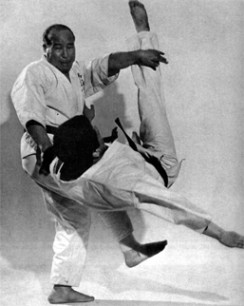
Born Choi Yeong-Eui in Korea, Mas Oyama began his martial arts journey at a young age. He moved to Japan and trained in various martial arts, including Shotokan karate and Judo, achieving high ranks in both. After World War II, Oyama sought a deeper understanding of the martial way (Budo). He retreated to the mountains for solitary, intense training, where he developed the principles that would form Kyokushin.

A legendary figure, Oyama became famous for his demonstrations of strength, which included fighting and killing bulls with his bare hands. He opened his first dojo in Tokyo in 1953, and in 1964, he officially established the International Karate Organization (IKO) Kyokushinkaikan. His goal was to create a karate style that was practical, effective, and centered on the spiritual and moral values of Budo.

The Aim of Kyokushin

The largest selection fitness articles exercises workouts, supplements, & community to help you reach your goals!

Add Your Heading Text Here

The core aim of Kyokushin is to forge a well-rounded individual through intense physical and mental training. It is a philosophy of self-improvement that extends far beyond the dojo, a way of life that instills valuable character traits. The ultimate goal is to embody the Kyokushin spirit, which can be broken down into several key objectives:

l To Seek the Ultimate Truth: The name “Kyokushin” itself encapsulates this aim. It’s about confronting and overcoming your own limitations—both physical and psychological—to discover your true inner strength and purpose.


l To Cultivate an Indomitable Spirit: Through rigorous, full-contact training and physical conditioning, practitioners learn perseverance, mental fortitude, and the ability to endure hardship. This “spirit of Osu” teaches you to push past what you think are your limits.


l To Develop a Pure and Moral Character: Kyokushin is not merely about fighting techniques. Its philosophy, mottoes, and dojo oath emphasize respect, humility, integrity, and kindness. The aim is to develop a morally upright individual who is a contributing member of society.


l To Achieve a Balance of Body, Mind, and Spirit: Kyokushin training is a holistic pursuit. It seeks to create harmony by combining physical strength, mental discipline, and spiritual awareness. This balance leads to a more confident, resilient, and centered individual.

The Authentic Kyokushin Spirit

The largest selection fitness articles exercises workouts, supplements, & community to help you reach your goals!

The authenticity of Kyokushin lies in its uncompromising approach to reality and its focus on developing the whole person. This is what sets it apart from many other martial arts:

u Full-Contact Sparring: The emphasis on jissen kumite (real fighting) is the most defining characteristic. Practitioners engage in full-contact sparring without pads or gloves (though punches to the head are restricted), forcing them to confront their fears and test their techniques in a realistic scenario.


u Intensive Physical Conditioning: The training is famously tough. It includes rigorous calisthenics, weight training, and body conditioning drills to build a body capable of both giving and taking powerful blows. This focus on “harden your body” is a core tenet.

u Emphasis on Budo: Kyokushin is a “Budo” (Martial Way) rather than a “Bujutsu” (Martial Technique). This means the purpose is not just to learn to fight, but to follow a path of self-perfection and spiritual growth. The physical training is a means to an end: building an indomitable will and a disciplined character.

Rules and Regulations of Kyokushin Karate

The largest selection fitness articles exercises workouts, supplements, & community to help you reach your goals!

Kyokushin is governed by a strict set of rules that apply both inside the dojo and during competitive bouts. These rules are designed to ensure safety, promote respect, and maintain the integrity of the art.


I. Dojo Rules & Etiquette

These rules are central to the practice and are designed to foster an environment of respect, discipline, and focus.

u Bowing: Bowing upon entering and leaving the dojo, to instructors, and to fellow students is a fundamental sign of respect.

u Silence: While training, students are expected to maintain silence and focus on the instructions of the Sensei.

u Respect for Instructors: Students must show unwavering respect to their Sempai, Sensei, and Shihan. The term “Osu” is used as a sign of understanding and affirmation.

u Cleanliness and Uniformity: The dojo and training uniform (Gi) must be kept clean. The Gi should be worn properly at all times.

Punctuality: Students are expected to arrive on time for class. If late, they must wait to be granted permission to join the class.

II. Tournament Rules (Kumite)

Kyokushin tournaments are known for their full-contact nature, but they are governed by specific rules to prevent unnecessary injury and maintain a fair fight.

Ø Legal Techniques:

l Strikes: All punches, elbow strikes, and open-handed strikes to the body are allowed. Punches to the head are generally prohibited in adult full-contact tournaments.

l Kicks: Kicks to the legs (gedan mawashi geri), body (chudan mawashi geri), and head (jodan mawashi geri) are all permitted and are a primary method of scoring.

l Knees: Knee strikes to the body and head are also legal.

Ø Illegal Techniques:

l Head Punches: Punching the face or head is a major foul.

l Grabbing & Grappling: Grabbing, grappling, throwing, or pushing an opponent is not allowed.

l Strikes to Forbidden Areas: Striking the groin, throat, spine, or joints is strictly forbidden.

l Other Fouls: Intentionally falling down, or intentionally striking a downed opponent, are grounds for disqualification.

Ø Scoring:

l Ippon (Full Point): Awarded for a clean, decisive knockdown that incapacitates an opponent for at least three seconds. Two waza-ari also equal one ippon.

l Waza-ari (Half Point): Awarded for a strong technique that visibly shocks or momentarily stuns an opponent.

l Minor Points: Other minor points may be awarded for dominant fighting, but these do not directly lead to a win unless they accumulate significantly over time.


Ø The Match: Fights are typically judged by a referee and four corner judges. Matches usually consist of a main round and one or more extension rounds if there is no clear winner. The winner is decided by knockout, Ippon, or the judges’ decision.

The Dojo Kun (Dojo Oath)

The largest selection fitness articles exercises workouts, supplements, & community to help you reach your goals!

The Dojo Kun is a set of guiding principles recited at the end of each training session. It was written by Sosai Mas Oyama and the famous Japanese writer Eiji Yoshikawa, author of “Musashi,” a book about the legendary swordsman Miyamoto Musashi. The oath serves as a reminder to practitioners that the training extends beyond the dojo and into their daily lives.

English Translation of the Dojo Kun:

Hitotsu, wareware wa, shinshin o renmashi, kakko fubatsu no shingi o kiwameru koto.

We will train our hearts and bodies for a firm and unshaking spirit.

Hitotsu, wareware wa, bu no shinzui o kiwame, ki ni hasshi, kan ni bin naru koto.

We will pursue the true meaning of the Martial Way, so that in time our senses may be alert.

Hitotsu, wareware wa, shitsujitsu goken o motte, kokki no seishin o kanyo suru koto.

With true vigor, we will seek to cultivate a spirit of self-denial.

Hitotsu, wareware wa, reisetsu o omonji, chojo o keishi, sobo no furumai o tsutsushimu koto.

We will observe the rules of courtesy, respect our superiors, and refrain from violence.

Hitotsu, wareware wa, shinbutsu o totobi, kenjo no bitoku o wasurezaru koto.

We will follow our religious principles and never forget the true virtue of humility.

Hitotsu, wareware wa, chisei to tairyoku to o kojo sase, koto ni nozonde ayamatazaru koto.

We will look upwards to wisdom and strength, not seeking other desires.

Hitotsu, wareware wa, shogai no shugyo o karate no michi ni tsuji, Kyokushin no michi o matto suru koto.

                               All our lives, through the discipline of karate, we will seek to fulfill the true meaning of the Kyokushin Way.

The Kyokushin Belt System

The largest selection fitness articles exercises workouts, supplements, & community to help you reach your goals!

The Kyokushin belt system, or kyu-dan system, signifies a student’s progress and dedication. The colored belts (Kyu grades) represent the different stages of learning before a student reaches the black belt (Dan grades). Each color holds a symbolic meaning related to the student’s journey.

u White Belt (10th Kyu): Represents purity and the beginning of a journey. The student starts with no prior knowledge and has an open mind to learn.

u Orange Belt (9th & 8th Kyu): Symbolizes the first rays of sunlight on the mountain path. The student begins to stabilize their foundation and develop basic techniques.

u Blue Belt (7th & 6th Kyu): Represents the sea and the sky. The student is starting to get a feel for the flow of their movements and is developing a more fluid and flexible style.

u Yellow Belt (5th & 4th Kyu): Symbolizes the fire or the sun, signifying the development of power and focus. The student is beginning to generate heat and energy in their techniques.

u Green Belt (3rd & 2nd Kyu): Represents a plant breaking through the soil. The student’s techniques are taking root and are becoming more grounded and powerful. They have developed a strong foundation.

u Brown Belt (1st Kyu): Represents the soil, signifying maturity, practicality, and readiness. The student is nearing the end of their beginner’s journey and is prepared to teach and guide others while continuing their own training.

u Black Belt (1st Dan & Above): Represents the opposite of white, but not an end. The black belt is a symbol of mastery of the basics, not of perfection. It represents the start of a new, more profound journey where a practitioner’s knowledge and skill are challenged and deepened.

The Kyokushin Honorific System

The largest selection fitness articles exercises workouts, supplements, & community to help you reach your goals!

In Kyokushin, as in many traditional Japanese martial arts, titles are used to show respect for a person’s rank, experience, and role in the dojo. These titles are not just labels; they represent a significant step in one’s martial arts journey.

l Sempai (Senior Student): This title is given to a senior colored belt, typically a green or brown belt, who is a positive role model and assists in teaching and guiding junior students. In many Kyokushin organizations, this title is also used for a 1st or 2nd Dan Black Belt. The Sempai represents a bridge between the teacher and the beginner students.

l Sensei (Teacher): This title is reserved for a high-ranking instructor, specifically a 3rd or 4th Dan Black Belt. The title means “one who has gone before,” acknowledging their profound experience and wisdom. A Sensei is a teacher in the truest sense, responsible for instructing students and leading a dojo.

l Shihan (Master Teacher): This prestigious title is given to a high-ranking black belt, typically 5th Dan or higher. Shihan signifies a master of the art, someone who has not only mastered techniques but also embodies the Kyokushin spirit and has a deep philosophical understanding of the art. A Shihan is seen as a leader and a lifelong master of the discipline.

l Hanshi (Venerable Master): One of the highest honorifics, Hanshi is reserved for the most senior and respected masters, typically those who have reached 8th Dan or higher. This title denotes not only exceptional technical skill but also a profound moral and philosophical understanding of the Martial Way. A Hanshi is a living embodiment of the art’s wisdom.

Benefits of Kyokushin

The largest selection fitness articles exercises workouts, supplements, & community to help you reach your goals!

Practicing Kyokushin offers a wide range of benefits for both physical and mental well-being:

l Physical Benefits: It is a full-body workout that improves cardiovascular health, muscular strength, endurance, and flexibility. The rigorous training helps with weight management, improves coordination, and strengthens the immune system.

l Mental and Emotional Benefits: Kyokushin provides a powerful outlet for stress relief. The intense training helps reduce tension, anxiety, and depression. It significantly boosts self-confidence and self-esteem by teaching you to overcome fear and push through discomfort. Practitioners develop focus, discipline, and a strong sense of responsibility.

l Character Development: The philosophy and training instill a sense of humility, respect, and perseverance. The Dojo Kun and Eleven Mottoes are not just words but guiding principles for a life of purpose, integrity, and moral strength.

The Eleven Mottoes

The largest selection fitness articles exercises workouts, supplements, & community to help you reach your goals!

Sosai Mas Oyama summed up his entire martial arts philosophy in these eleven mottoes. They are central to his teachings and provide a deeper understanding of the Kyokushin spirit.

1) The Martial Way begins and ends with courtesy. Therefore, be properly and genuinely courteous at all times.

2) Following the Martial Way is like scaling a cliff – continue upwards without rest. It demands absolute and unfaltering devotion to the task at hand.

3)  Strive to seize the initiative in all things, all the time guarding against actions stemming from selfish animosity or thoughtlessness.

4)  Even for the Martial Artist, the place of money cannot be ignored. Yet one should be careful never to become attached to it.

5)  The Martial Way is centered in posture. Strive to maintain correct posture at all times.

6)  The Martial Way begins with one thousand days and is mastered after ten thousand days of training.

7)  In the Martial Arts, introspection begets wisdom. Always see contemplation on your actions as an opportunity to improve.

8)  The nature and purpose of the Martial Way is universal. All selfish desires should be roasted in the tempering fires of hard training.

9)  The Martial Arts begin with a point and end in a circle. Straight lines stem from this principle.

10)  The true essence of the Martial Way can only be realized through experience. Knowing this, learn never to fear its demands.

11)  Always remember, in the Martial Arts the rewards of a confident and grateful heart are truly abundant.

Kyokushin Symbols & Meaning

The largest selection fitness articles exercises workouts, supplements, & community to help you reach your goals!


The visual identity of Kyokushin is defined by two key symbols: the Kanku and the Kanji. Both carry deep philosophical meaning and represent the core principles of the style.


I. The Kanku Symbol

The Kanku symbol is derived from the opening section of the Kanku Dai kata, where the practitioner raises their hands and looks up at the sky. Sosai Mas Oyama adapted this gesture into the emblem of the International Karate Organization.


Ø The symbol is rich with meaning: The Two Pointed Fingers: These represent the heavens and the earth, signifying the balance between them.

Ø The Center Circle: This represents a point of infinity or the “Ultimate Truth.” It is the goal that every Kyokushin practitioner strives to reach.

Ø The Thick Outer Circle: This represents the protective barrier of one’s body, the inner circle of the heavens and earth, and the external world.

Ø The Points: The outer points represent the four corners of the world, reminding us that Kyokushin is universal.

The Kanku as a whole represents the pursuit of the ultimate truth through the body and mind, within the confines of the universe.


II. The Kyokushin Kanji

The official name of the organization is Kyokushinkaikan, written in three distinct Japanese Kanji characters. Each character has a specific and powerful meaning:


Ø  (Kyoku): This character means “ultimate,” “extreme,” or “pinnacle.” It represents the rigorous training and the relentless pursuit of perfection that defines Kyokushin.

Ø  (Shin): This character means “truth” or “reality.” It symbolizes the philosophy of confronting one’s true self and pushing past physical and mental illusions.

Ø 会館 (Kaikan): This character means “association,” “organization,” or “hall.” When combined, it signifies the collective body of students and instructors who have dedicated themselves to the Kyokushin Way.


Together, the full name Kyokushinkaikan (極真会館) translates to “The Association of the Ultimate Truth,” reflecting the organization’s mission to seek truth through the martial art.